
Failed Your Kerala RTO Driving Test? Fix These Mistakes Before Your Retest
Failed Your RTO Driving Test in Kerala? Here's Exactly What to Fix Before You Retake It
Introduction
You walked out of the RTO ground with your heart sinking. Maybe the car stalled on the gradient. Maybe the two-wheeler wobbled on the 8-track. Maybe you simply froze at the reverse parking cone and the examiner's clipboard did the rest. Whatever happened, the first thing to understand is this: failing the RTO driving test is one of the most common and most fixable setbacks a new driver faces — and it is almost never a sign that you "can't drive." It is a sign that one specific, identifiable skill needs more practice before your next attempt.
This guide breaks down exactly why learners fail the LMV and two-wheeler driving test in Kerala, what the retest process actually involves, and — most importantly — precisely what to fix so your next attempt is your last one.
Why RTO Test Failures Are More Common Than You Think
If you failed your test, you are in the company of a very large number of first-time learners. Kerala's RTO test is deliberately structured to check real-world control under pressure, not just whether you can move a vehicle in a straight line. Examiners are specifically trained to watch for a handful of high-risk mistakes, and even confident learners often slip on one of them simply because it wasn't practised enough during the standard course. Understanding which mistake cost you the test is the single most useful thing you can do before your next attempt.
Top Reasons Learners Fail the LMV (Car) Driving Test
If you were testing for your LMV licence, your failure almost certainly falls into one of these categories:
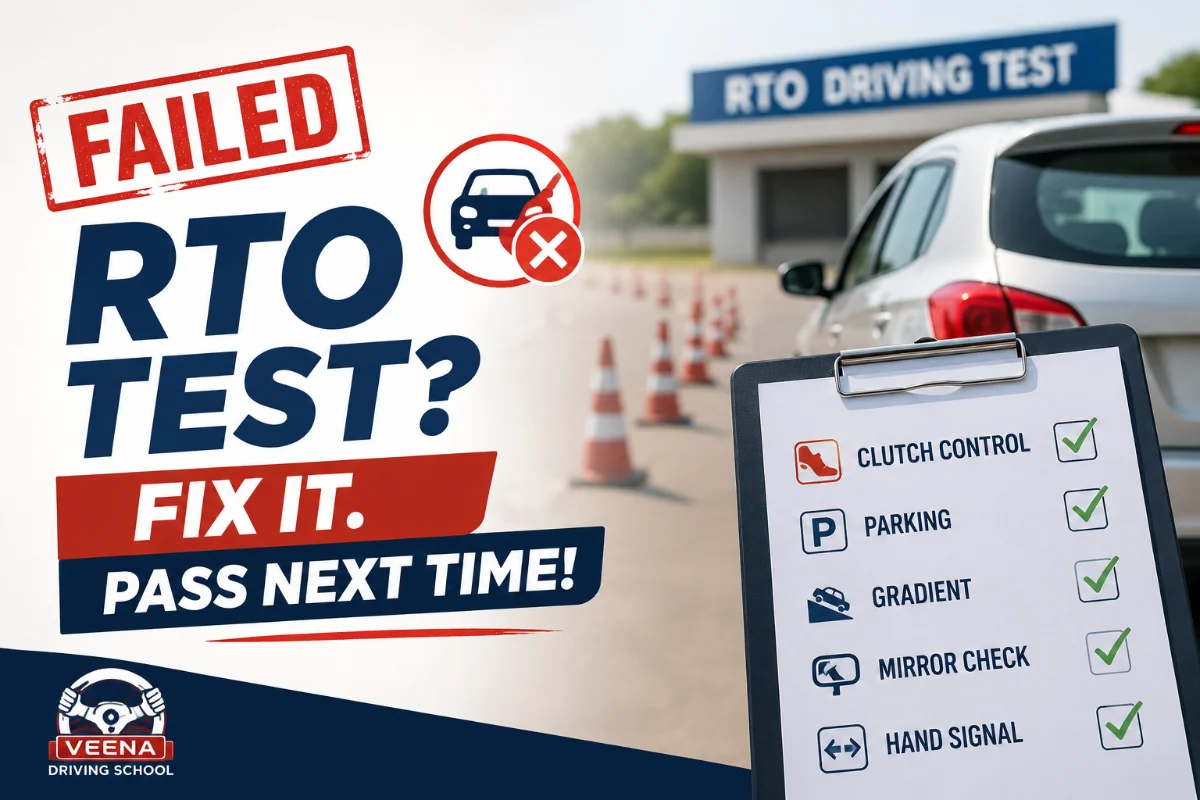
Stalling the engine on clutch control. This is, by far, the single most common reason learners fail. A stalled engine at a junction or during the gradient test signals to the examiner that clutch-accelerator coordination isn't yet second nature. It's rarely about nerves alone — it's about not having spent enough seated hours building muscle memory for the biting point.
Reverse parking or parallel parking. The parking segment is where composure matters as much as skill. Many learners who drive well on the open road lose points here because they rush the mirror checks, misjudge the angle, or touch a cone while correcting.
Rolling back on the gradient (hill-start) test. Even a slight roll-back on the incline is marked as a control failure. This comes down to handbrake-clutch-accelerator timing, which needs dedicated slope practice, not just flat-ground driving.
Skipping mirror checks and hand signals. Examiners are trained to watch your head movement and mirror glances as closely as your steering. Many learners physically check the mirror in daily practice but forget under test pressure, which is an easy fix with targeted repetition.
Hesitation and under-confidence at junctions. Ironically, over-caution can cost as many marks as recklessness. Long, unnecessary pauses at junctions or roundabouts suggest indecision, which examiners read as a lack of road readiness.
Top Reasons Learners Fail the Two-Wheeler Driving Test
For two-wheeler licence candidates, the failure pattern looks a little different, since the test focuses heavily on balance and low-speed control:
Putting a foot down on the 8-track (figure-of-8): the single most common two-wheeler test failure. It reflects insufficient practice at very low speeds, where balance is hardest to hold.
Wobbling during slow-speed riding: riding too fast feels safer to beginners because the bike is more stable, but the test specifically checks controlled slow riding.
Missing hand signals before turns: just like the LMV test, forgetting to signal is an automatic mark-down even if the turn itself was executed well.
Knocking or grazing a cone: usually caused by misjudging the width of the track rather than a genuine balance issue, which is a spatial-awareness fix, not a riding-skill fix.
Sudden braking causing instability: panic braking on the test track often comes from insufficient practice on emergency stops at controlled speed.
What Happens After You Fail: The Retest Process in Kerala
Failing a test is not the end of the road, literally. Your learner's licence remains valid, so you don't need to restart the entire application process. You simply need to book a retest slot through your RTO, which is usually available within a reasonable window depending on local slot availability. Your driving school can often help you check and secure this. There is no cap on the number of retests you can take within your learner's licence validity period, so a failed attempt is a delay, not a dead end.
The real problem usually isn't you, it's the prep. Standard driving courses are built to cover the full syllabus in a fixed number of sessions. If you failed on one specific segment, generic practice sessions won't fix it. You need focused, repeated drilling on exactly that skill.
How Veena Driving School's Remedial Training Gets You Through the Retest
At Veena Driving School, we don't put retest students through the entire course again. After 25 years of training drivers in the Changanacherry–Kottayam region, we've seen every version of this problem, and our approach is built specifically for it:
Diagnostic session first: before any retest preparation begins, our instructors identify exactly which segment caused the failure — clutch control, parking, gradient, or balance — instead of guessing.
Focused remedial sessions: practice is concentrated entirely on the weak skill, using our dedicated training ground at Paippad on NH 183, which has the space to simulate gradient tests, parking bays, and low-speed tracks realistically.
Mock test simulation: we run a simulated RTO-style test under similar pressure conditions, so the real test day doesn't feel unfamiliar.
One-on-one attention: retest students work closely with instructors matched to their exact course — rather than being placed in a general batch.
RTO formality support: our team assists with the retest booking and paperwork so you're not navigating that process alone on top of the actual driving prep.
This is the same structured, skill-specific philosophy behind our Road Confidence programme, which many of our retest students graduate into afterward, because passing the test and driving confidently in real traffic are two different skills, and we build both.
Conclusion
If you're reading this after a failed test, take a breath. A failed RTO test is a data point, not a verdict. It tells you precisely one thing you need to work on, and once you know what that is, fixing it is usually a matter of days of focused practice, not months. Thousands of confident drivers on Kottayam's roads today failed their first attempt too. What separated them from a second failure wasn't talent, it was targeted preparation.
Book a diagnostic session with Veena Driving School and let our instructors pinpoint exactly what to work on before your next RTO attempt.
Veena Driving School (Veena Corporation)
Booking Office: Revenue Tower, Changanacherry, Kottayam
Training Ground: Paippad, NH 183
Phone / WhatsApp: +91 9947 394 210
Email: info@veenacorporation.com
Website: veenacorporation.com
Explore our other programmes: HMV Heavy Vehicle Training, Trailer/HTV Course, LMV Car Driving Course, Two-Wheeler Course, Road Confidence Programme.